
Top 5 Dangers of Drones in Crowded Spaces

Unmanned Aerial Vehicles (UAVs) have become a permanent fixture in modern airspace. Today, tens of thousands of licensed operators are registered with regulatory bodies like the UK Civil Aviation Authority (CAA).
However, the proliferation of these craft over densely populated environments presents an acute operational challenge. When event organisers and security directors ask, "Are drones dangerous?" the answer is increasingly complex. From accidental incursions by careless hobbyists to deliberate surveillance, the dangers of drones have evolved into a primary security concern for stadiums, open-air arenas, and transport hubs.
To fully understand why drones are dangerous, we must examine the modern threat landscape. Security teams must now defend against a wide spectrum of aerial threats. In recent years, we have seen a dramatic escalation in hostile activity. In October 2025, Munich Airport was forced to halt operations for two days due to coordinated drone sightings.
Even more alarming, in August 2026, an explosive-laden UAV breached the perimeter of Leipzig-Halle Airport, marking a severe escalation in European aviation threats. These events highlight that the problems with drones extend far beyond nuisance behaviour. They represent a severe threat to public safety and infrastructure.
Key Dangers of Drones in Populated Areas
While UAV technology offers immense benefits for broadcasting and logistics, the disadvantages of drones when flown irresponsibly are profound. To help security professionals future-proof their perimeters, we have outlined the top 5 disadvantages of drones and the most critical risks they pose in densely populated areas.
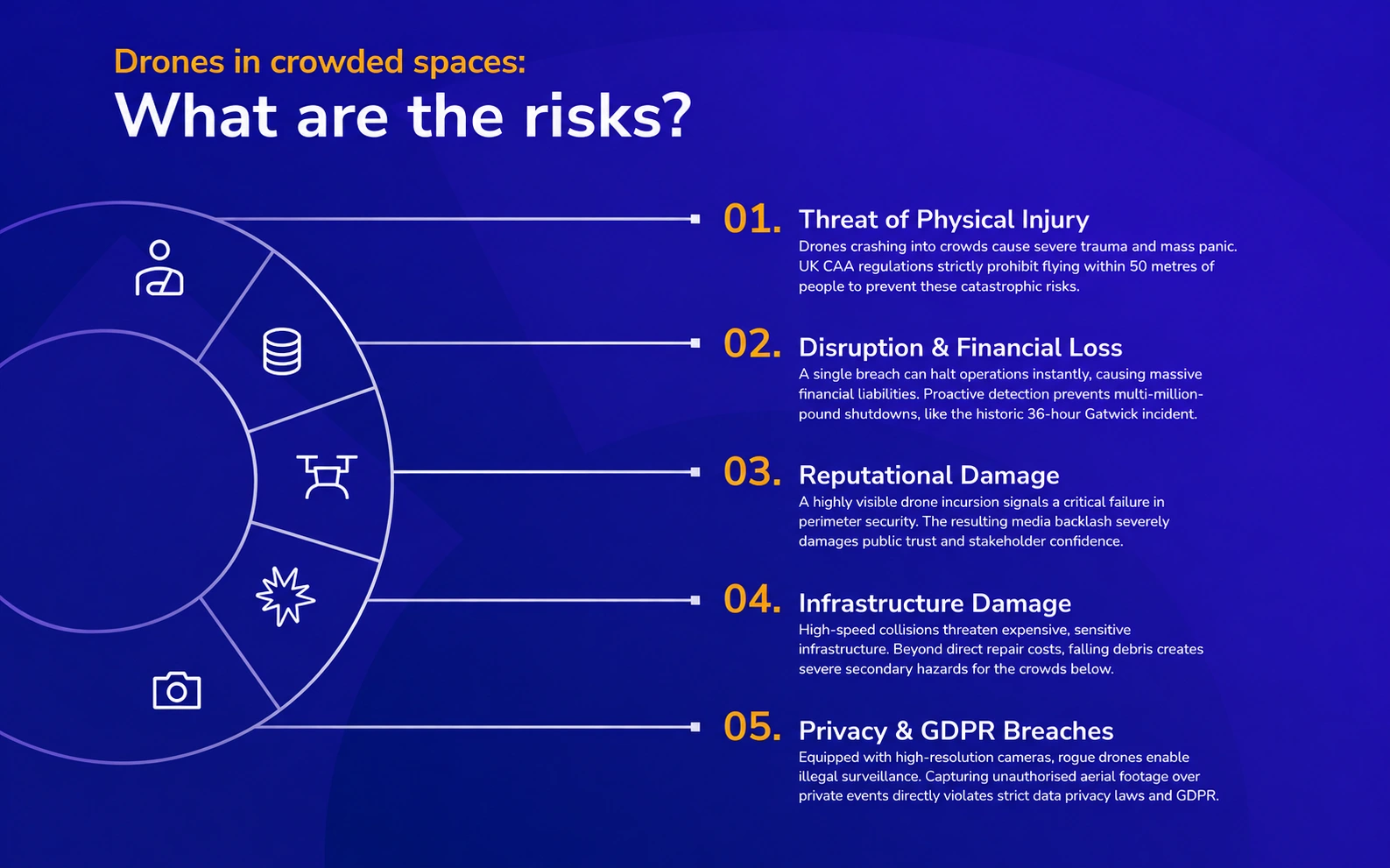
1. Injury to Others
When operating above crowds, immediate physical drone danger is the top priority. Even lightweight consumer models can cause severe, life-threatening injuries if a motor fails, a battery depletes, or a control signal drops.
Understanding exactly what a drone does to your body upon a high-speed impact, ranging from deep lacerations from carbon-fibre propellers to blunt force trauma, highlights the severe risk of allowing unauthorised flights over dense gatherings. Beyond direct impact, unexpected drone hazards can trigger mass panic, distracting vehicle operators or disrupting live safety protocols.
The UK CAA 50-Metre Rule: All sites must be fully aware of official regulations. The UK Civil Aviation Authority strictly mandates a 50-metre horizontal separation between UAVs and people, buildings, or transport vessels. Flying over crowds within this invisible cylinder is strictly illegal. You can read the full guidelines on where you can fly via the official CAA drone code.
2. Financial Losses and Operational Disruption
When people list the bad things about drones, financial loss is often underestimated. When a breach occurs over a crowded environment, the economic fallout is swift. Venues and transport operators face massive financial liability, including emergency response costs, ticketing refunds, and compensation claims. If a collision causes injury, liability suits can reach millions.
An unverified aerial threat often forces a mandatory suspension of operations. The historic 2018 Gatwick Airport incursion, which halted flights for 36 hours, cost the airport and airlines an estimated £14 million in immediate disruption. As demonstrated by our long-standing London Heathrow Airport airspace defence, implementing proactive detection prevents costly shutdowns and keeps operations running smoothly.
3. Reputational Damage and Loss of Trust
In an era of instant digital communication, public awareness of drone risks is at an all-time high. Visitors, VIPs, and commercial tenants rightfully expect high-profile venues to provide comprehensive security. A high-visibility incursion, even one ending without injury, signals a critical failure of perimeter control. The resulting news coverage and social media backlash can erode public trust and compromise stakeholder confidence.
4. Damages to Infrastructure and Property
Beyond human injury, unauthorised flights pose a direct threat to physical property. Crowded sites house expensive, sensitive infrastructure, such as stage lighting, broadcast arrays, high-voltage equipment, and glass architectural structures.
Significant drone damage to these assets leads to complex repairs, prolonged downtime, and severe secondary hazards if structural debris falls into a crowd. Protecting physical infrastructure requires detecting rogue operators long before they breach the facility perimeter.
5. Violation of Public Privacy and GDPR Breaches
Modern UAVs are routinely equipped with high-resolution electro-optical cameras, thermal sensors, and directional microphones. When flown over corporate events or stadiums, they represent an invasive tool for illegal surveillance and harassment. The UK Civil Aviation Authority explicitly warns that any photographs or video recordings captured from the air are subject to strict data privacy laws, including the General Data Protection Regulation (GDPR).
The Next Horizon: Coordinated Multi-Drone Attacks
Managing crowded space drones is no longer just about stopping a lone, reckless hobbyist. Modern venue defence must account for sophisticated, coordinated aerial threats designed to bypass legacy security measures.
1. Multi-Vector Coordinated Incursions
We are witnessing a sharp rise in tactics involving multiple UAVs operating simultaneously. Operators may deploy a decoy at high altitude to intentionally trigger venue alarms and draw security resources to one side of a stadium. While sensors are focused on the decoy, a secondary, low-flying payload breaches the opposite flank undetected.
2. Simultaneous Saturation
The rapid evolution of artificial intelligence and autonomous flight systems has made multi-drone saturation a realistic threat. A coordinated fleet navigating without active radio frequency (RF) command links can execute pre-programmed, GPS-denied flight paths. These coordinated clusters can easily overwhelm basic, single-sensor detection systems.
Elevating Venue Defence: Moving Beyond Legacy Detection
Traditional standalone RF scanners or simple optical cameras are incapable of processing simultaneous, multi-angle incursions without generating severe data latency or system blind spots. As technology evolves towards autonomous flight paths and non-emitting RF systems, basic RF scanners can't guarantee site security.
To truly safeguard crowded spaces, security leaders must deploy continuous, real-time situational awareness. At OSL Technology, we engineer complete counter-drone systems (CUAS) and solutions tailored to complex public environments.
By integrating passive RF detection, long-range radar, and high-definition optical tracking into our proprietary FACE C2 Data Fusion Platform, we deliver a unified, zero-latency operational picture.
Why Multi-Layered Defence Wins:
- True Sensor Fusion: Fusing multi-domain data to eliminate false alarms caused by birds, balloons, or authorised media flights.
- AI-Powered Visual Verification: Leveraging advanced edge analytics to autonomously classify and track targets in complex environmental clutter.
- Pilot Localisation: Pinpointing the exact ground coordinates of the unauthorised operator or remote pilot to direct law enforcement immediately.
- Future-Proof Scalability: An open-systems approach that easily adapts to protect stadiums, open-air arenas, and public festivals.
Backed by our deep engineering heritage as part of the Terma Group, OSL delivers field-proven airspace security designed to keep complex venues safe, compliant, and operational without disruption.
Frequently Asked Questions (FAQs): Drones in Crowded Spaces
What is the legal distance a drone can fly near crowds in the UK?
Under UK Civil Aviation Authority (CAA) regulations, unauthorised flights must maintain a minimum horizontal separation of 50 metres from people, buildings, and transport vessels. Flying directly over crowded events, sports stadiums, or music festivals is strictly illegal without specialised commercial waivers.
How can public venues detect unauthorised drones without triggering false alarms?
Legacy scanners often struggle in crowded urban environments, frequently triggering alarms from passing birds or broadcast equipment. Modern venues overcome this by deploying multi-layered counter-drone systems (C-UAS) that fuse long-range radar, passive radio frequency sensors, and AI-driven optical tracking to verify threats in real time.
Can security teams intercept or shoot down a rogue UAV over a crowded stadium?
Kinetic interception over a crowded public space presents severe safety risks from falling debris and uncontrolled crash landings. Instead, venues rely on non-kinetic soft-kill countermeasures, such as precision RF jamming or protocol manipulation, to safely sever the command link and force a safe landing.
Why are basic radio frequency scanners no longer enough for event security?
While basic RF scanners can detect traditional consumer models, modern threat actors increasingly deploy autonomous UAVs. These can navigate using pre-programmed waypoints without emitting radio signals. Defeating non-emitting or multi-vector threats requires an open, multi-layered security architecture that combines radar, electro-optical cameras, and artificial intelligence.
Does unauthorised aerial surveillance over public events violate UK privacy laws?
Yes. Unauthorised flights equipped with high-resolution cameras, thermal imaging, or directional microphones operating over public gatherings can breach data privacy laws. This includes protections under the General Data Protection Regulation (GDPR). Event organisers have a legal obligation to protect visitors from illegal aerial surveillance by actively monitoring their site airspace.
Editor's Pick

Secure your airspace with adaptive drone defence solutions
Ensure operational safety with multi-layered solutions designed to counter unauthorised drones and protect complex environments.